
Our vision: let seniors live with dignity and autonomy in familiar surroundings until the very end
DoctorNow Home medical care + AngelCare care services join forces to support every senior living with dignity and autonomy in familiar surroundings. This assessment tool helps you clarify “home or care home” — supporting families who want to age in place more confidently, while honestly guiding families who truly need residential care.
Elderly Care Options
Elderly Care Options
Elderly Care Options
A complete guide Aging in place vs. residential care
In Hong Kong, 1 in 3 seniors faces the choice of “staying home or moving into a care home”. According to SWD statistics, about 150,000 seniors are on the waiting list for subsidised care home places, with an average wait of up to 3 years, while over 70% of seniors clearly say they want to age in place. Many people feel lost when deciding whether a relative should enter a care home or stay at home.
To help more families find their way, follow the structured assessment process below and review the key factors step by step — from the senior's health and wishes to the family's care capacity and resources — to give the home-or-home-choice a clearer direction.
1. Elderly care falls into four types
1. Elderly care falls into four types
Elderly care can be divided into the following four types:
Home care
The preferred model: autonomous aging in place
Home care + community support
For mild impairment with insufficient family care resources
Residential care home
Moderate-to-severe impairment + insufficient family manpower + adequate finances
Premium care institution
High financial capacity + clear quality-of-life requirements
2. The aging-in-place assessment process:
Assessment process:
To better arrange the senior's care and realise these advantages, we assess step by step as follows: the process has three steps (orange/brown) and requires completing five assessment tools (green).
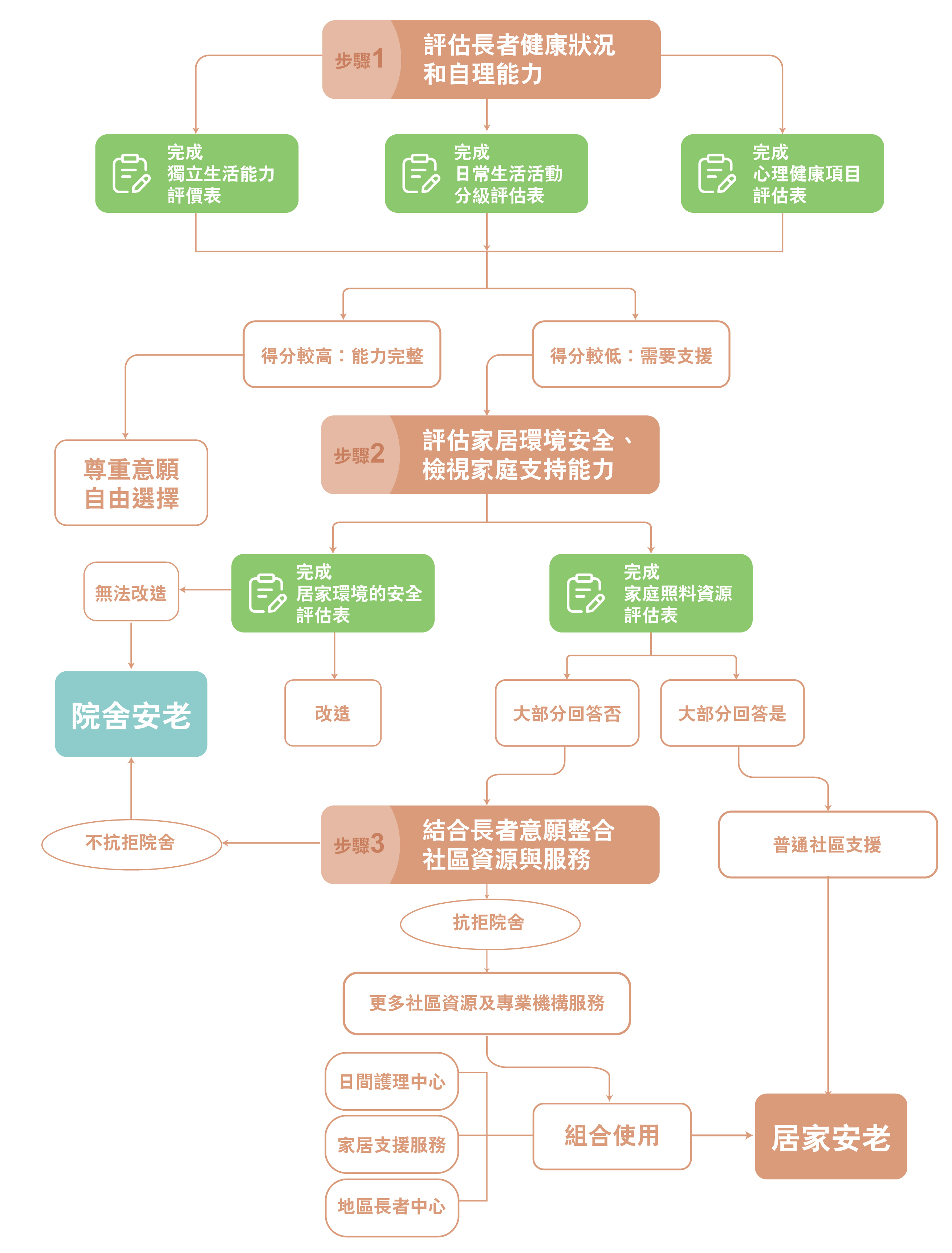
Step 1:
Assess the senior's health and self-care ability
Click to complete:
Assess the senior's self-care ability
- Mild impairment (slower but independent, e.g. walks with a cane): prioritise home care. Combined with day care centres (124 across Hong Kong) and meal delivery, monthly costs can be 40% lower than a care home.
- Moderate-to-severe impairment (long-term bedridden, cognitive impairment): assess whether the family can provide 24-hour care, or combine professional in-home nursing (physiotherapy, wound care).
- Sudden health deterioration (post-stroke rehab): needs short-term intensive support (carers at home, rehab equipment rental) plus a long-term plan.
If the senior's independent living ability, basic self-care and mental state are good, they can choose to live independently at home or in another place they love. If there is some impairment, further assess family care resources and home safety, then seek community or institutional support based on the results to decide the right care plan.
- Local home carer: $100–150/hour, to be combined with the government's Community Care Service Voucher subsidy
- Equipment rental:
- Wheelchair: $200–500/month
- Cane: $50–100/month
- Walker: $100–300/month
- Hospital bed: $800–1,500/month
- Oxygen concentrator: $500–1,000/
- Rehab equipment (e.g. gait trainer): $300–600/month
Step 2:
Assess home safety and review family support capacity
Click to complete:
Review family support capacity
- Full-time caregivers: over 35 care hours per week raises depression risk 3×.
- Working caregivers: with long hours or living apart, rely on flexible community services (extended day care, respite services).
- No caregiver: hire a domestic helper combined with smart monitoring (emergency call devices, fall sensors).
- Apply for respite services($120/day, book 2 weeks in advance)
- Make good use of technology:Fall-detection wristband ($300/month) + 24-hour emergency alarm with voice call
- Hire a domestic helper:Around $6,000/month + accommodation space
Assess home environment safety
- High-risk areas (slippery bathrooms, stairs without railings): carry out anti-slip work or accessibility modifications. If the home is too small to modify, consider moving or switching to a care home.
- Basic equipment: handrails, shower chairs, electric care beds, etc.
- Advanced equipment: health monitoring systems, emergency call devices.
- Low-cost options:Anti-slip tape ($200/metre), portable grab rails ($800)
- High-risk area modifications:
- Bathroom:Remove threshold + ramp (from $3,000)
- Bed area: electric care bed rental $1,500/month, saving 60% vs purchase
Step 3:
Integrate community resources and services with the senior's wishes
Seek community support
Service accessibility:Only 38% of home care services provide weekend support
- Day care centres: check waiting time (average 10 months) and whether service hours match your needs.
- Home support services: apply for Integrated Home Care Services (meal delivery, rehab) — note holiday service gaps.
- Combine Integrated Home Care Services (general / disability categories)
- Join district elderly centre mutual-support groups to share care resources
- Strong preference for home: try a 'hybrid model' (e.g. part-time care home respite).
- Resists care homes: strengthen psychological support and reduce loneliness through social activities (e.g. the Elderly Volunteer Scheme).
- Mental health assessment: if the elder shows depressive tendencies, intervene early with counselling or a psychiatrist.
A third path beyond home vs care home
Facing the limits of the traditional binary choice, Hong Kong is developing innovative models:
- Hybrid care:
Home on weekdays + residential respite on weekends (suited to families with working children) - Co-living apartments:
5–6 senior households share a common living room and split 24-hour care costs - Technology: AI behaviour detection can predict fall risk 3 hours in advance
3. When should residential care be considered?
Aging in place is not a cure-all. When the following warning signs appear, it is time to realistically consider a change of plan:
- Health indicators: monthly fall frequency
- Family system:Primary carer showing serious physical or mental symptoms
- Environmental limits:Tiny flat cannot accommodate necessary equipment (e.g. stairlift)
Worth noting: the current Residential Care Service Voucher scheme lets seniors first enter a private home (about $15,000/month), then switch to a subsidised place using the voucher — a viable transitional option.
Residential care provides comprehensive care but sacrifices autonomy. Lack of family company, cramped space and rigid routines can leave seniors feeling lonely, losing privacy, and facing social isolation and psychological problems.
About 60,000 seniors currently live in residential care homes, around 4% of the population aged 65+. As of 31 January 2023, 18,145 people were waiting for subsidised residential care services, with an average wait of 16 months for RCHE places and 19 months for nursing home places. Because of the tight waiting list, many seniors have no choice but private homes, where fees range from about $4,000 to $20,000 per month. However, quality varies widely among private homes and some are understaffed. Despite tighter government regulation, quality problems persist.
Private care home fee breakdown
| Accommodation $7,000−15,000/month | |
| Nursing care $500−2,000/month | |
| Air conditioning $400−700/month (seasonal) | $400/month (Oct–Apr) $700/month (Jun–Sep) |
Diabetes care | Insulin needles $800−1,200/month Blood test $30/time (monthly rate negotiable) Insulin injection $30/shot (monthly rate negotiable) Syringe/needle $41 each Alcohol swabs $30/box (100 pcs) Lancet $3 each Blood glucose test strips $8 each |
Nasogastric tube care $1,000−2,000/month | Measuring cup x1 $40 Feeding bottle x1 $100 Forceps (mouth care) x1 $120 Plastic container $50 Syringe $40 Gastric juice test strips $150 Tube connector $450 Mouth-care gauze from $20/pack 3M tape from $20/roll Milk bag $15 each |
Peritoneal dialysis $1,200−2,200/month | Dialysis 1–2 times/day $1,200 Dialysis 3–4 times/day $1,800–$2,200 Consumables billed at actual cost |
| Diapers $1,800−3,360/month | |
| |
| NG tube supplies $40−450/month |
| Wet wipes (large) $45/pack (80 pcs); wet wipes (small) $25/pack (80–100 pcs) | |
| Haircut $30/time | |
| Safety belt $30 each; safety vest $250 each | |
| Air-conditioning quilt $400 each | |
| Plastic sheet $100 each | |
| Pillow $100 each | |
| Toilet paper roll pack $35 (10–12 rolls) | |
| Bed sheet, pillowcase and duvet cover set $380 | |
| Durable urinary catheter $100 each | |
| Restraint board $250/set (2 pcs); restraint wristband $250/pair (2 pcs) | |
| Urine bag/stand/sheath $20 each | |
| Alcohol swabs $30/box | |
| Face towel $10 each | |
| Anti-slip pants $250 each | |
| Disposable gloves $10/pack |
| Suction (incl. equipment and tube) $60/time | |
| Wound cleaning (incl. cotton and solution) $60–80/time | |
| Emergency oxygen $100/time (30 min); mask and tube $80/set |
| Bed fee $1,200 (first admission); new mattress $1,000 | |
| Annual linen replacement $500/year | |
| Clinic escort fee $500/year |
Note: all fees may be adjusted annually; some items are billed at actual cost.
4. Final decision:
1. Aging in place:
“Mild impairment + adequate family support + safe home + community services in place”
2. Short-term residential support:
For carers needing respite or in emergencies
3. Residential care:
When “health seriously deteriorates + family cannot cope + community resources are insufficient”, prioritise a nearby care home or join the Residential Care Service Voucher scheme.
Important notes

- Policy limits: caregiver allowances have few places and may conflict with other benefits — plan carefully.
- Service flexibility: some community services have rigid hours (e.g. no weekend meal delivery) — coordinate in advance.
- Long-term planning: regularly re-assess the elder's health changes and family load, adjusting the plan dynamically.
Aging in place vs. residential care
Loading..........
The Data is Not Available
“The best care plan is one that keeps choices in the senior's hands.”
AngelCare's responsibility is to build a care network where dignity and safety coexist. Our philosophy is built on an integrated medical support system that maximises foreign domestic helpers as the core of the care team, monitoring health data comprehensively, intervening in time and flagging anomalies instantly — raising the quality and safety of aging in place and helping seniors achieve it.